
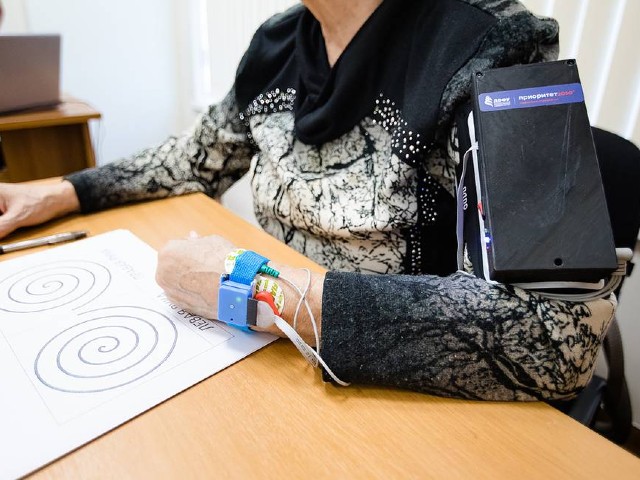
The first Russian anti-tremor neurostimulator that does not require implantation in the patient's body has been developed at the Dalnevostochny Federal University (DVFU). Serial production and sale of the device is planned to begin in two years, the university's press service told TASS.
"DVFU scientists are actively working on a prototype of an antitremor non-invasive neurostimulator and have already conducted several tests on patients with Parkinson's disease and essential tremor. The first results have shown that the domestic device reduces tremor up to 80% in some cases and with further positive dynamics will be able to replace foreign analogs. <...> After a full set of tests, scientists plan to release a pre-production sample, reducing the size to a wristwatch and optimizing the stimulation algorithm. The domestic neurostimulator will enter the market after all procedures of medical registration, tentatively - in two years", - reported in the press service.
The first domestic prototype of the specialized neurostimulator was tested by five patients. Sensors of the device are attached to the arm, and impulses are transmitted through the skin, which allows to suppress tremor without surgical intervention. The device itself is attached to the forearm and feels like a phone when jogging. In parallel, work is underway on a prototype in the form of a bracelet to make it convenient for patients to use the device in everyday life.
According to Alexander Artemenko, a bioengineer at the Laboratory of Experimental and Translational Medicine at DVFU, positive dynamics can be traced, but tremor is reduced differently in each case. Artur Biktimirov, a leading neurosurgeon at the DVFU Medical Complex, specified that there is only one Western analog in the world, produced in the USA. Tremor can also be suppressed with the help of pills, which are not always effective, or surgery.
The development of a domestic anti-tremor non-invasive neurostimulator is supported by the "Priority 2030" program of DVFU.
Source of text and photo: https://nauka.tass.ru/nauka/19346535
-
 1
1
-
 0
0
-
 0
0
-
 0
0
-
 0
0
-
 0
0
